I explore how AI can support requirements, implementation and verification while keeping a record of the reasoning behind each decision. My focus extends beyond code generation to SQL analysis, specifications, reviews and documentation.
What to delegate to AI, and what people should decide.
The value of AI is more than the speed of its answers. It depends on the context provided, the scope delegated and the checks performed before accepting an output. These scenarios show how I structure that work.
01 / DEVELOPMENT ASSISTANT
Support changes to existing business systems
Adding a field or condition in isolation can overlook existing validation and automation. An AI request needs more context than the specific line of code to change.
01
Provide the context
Describe the relevant screens, logic, data fields and expected changes. Include existing behavior that must be preserved and the boundaries of the change.
02
Keep changes focused
Review the impact and proposed implementation before making changes. Favor small, explainable differences that are easy to understand and review.
03
Run and verify
Read the generated tests and compare them with actual execution results. Check the interface and data to confirm that existing features still behave as expected.
Example deliverables
Reviewable code changes, verification steps, test results and remaining limitations.
02 / ANALYSIS ASSISTANT
Find a starting point for investigating metric changes
The statement that this month's numbers are down is not yet a clear analytical question. Define the period, population and comparison conditions, then break the question into checks that can be tested.
01
Define the comparison
Distinguish a partial month from a full month, counts from amounts, and specify the records included. Also check for delays in data refreshes.
02
Turn hypotheses into checks
Treat AI explanations as hypotheses. Verify them with queries and aggregates by segment and period rather than accepting a plausible story as the conclusion.
03
Support explanations with evidence
Separate confirmed numerical changes from factors still to investigate. Record the comparison conditions, sources and next questions.
Example deliverables
An analytical question, validation queries, a summary of results and a list of follow-up investigations.
01 / DEVELOPMENT
Bring AI into every stage of development
From research to implementation and review, I explore how clear goals and context help make AI outputs useful and verifiable.
Organize the context
Clarify requirements, existing structure, constraints and expected behavior so the information needed for a decision is explicit.
Build in small steps
Break changes into small units and check both the code and execution results. Proceed with an understanding of what has been generated.
Verify before adopting
Combine tests, change reviews and interface checks to confirm that the implementation meets the requirements.
02 / DATA & BUSINESS
Connect AI, data and business
I explore AI as an aid to human judgment in analysis preparation, explanation and the organization of business knowledge.
Structure the analysis
Explore support for framing questions and writing SQL or SAQL, then reconcile aggregate results with source data.
Make knowledge easier to use
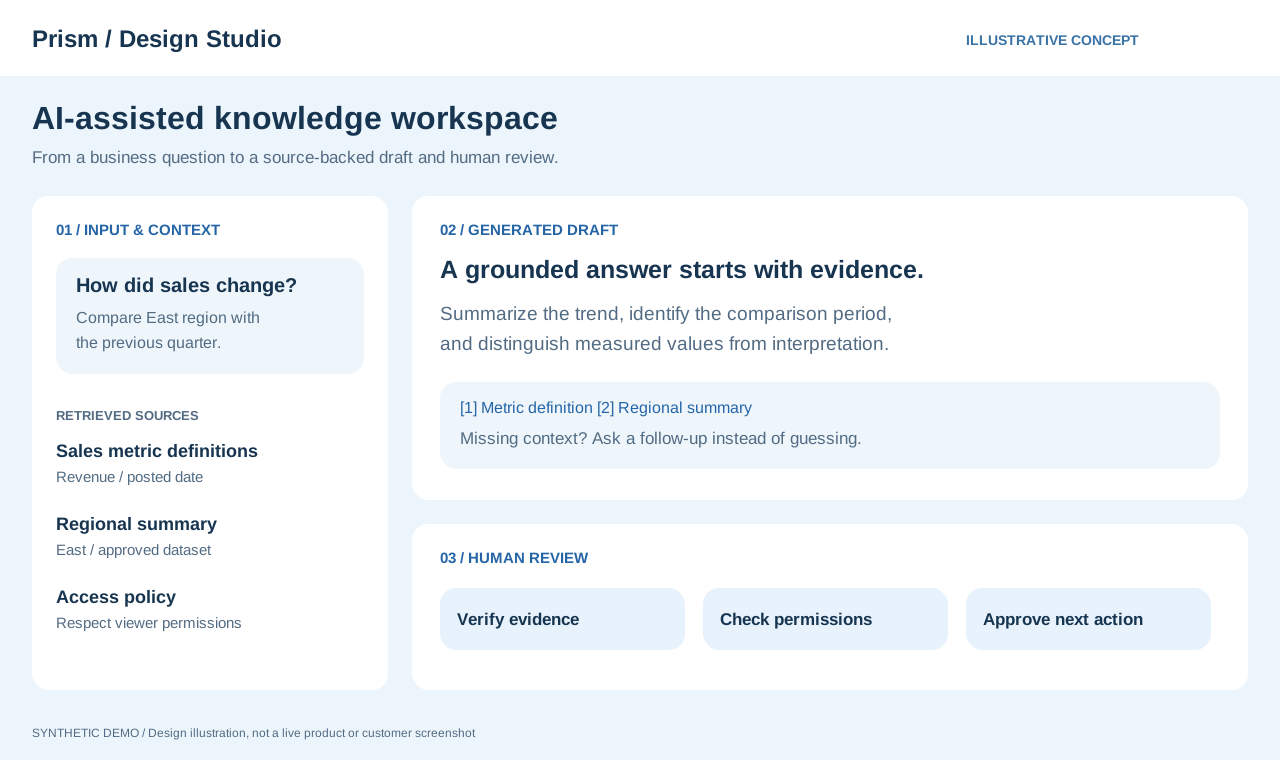
Explore document summaries and search assistance, with an emphasis on answers that can be traced to their sources.
Support business workflows
Consider assisted input, classification and drafting while retaining necessary checks and human decisions.
03 / PRINCIPLES
Design the conditions for responsible use
Convenience matters, alongside data handling, evidence and verification methods.
Limit the input
Define the scope and purpose of input data, avoiding information that is not needed for the task.
Check the evidence
Compare generated explanations and code with original sources and actual behavior before making a judgment.
Improve continuously
Record useful instructions, failed examples and verification methods to improve the next task.
DELIVERABLES / CLEAR HANDOFF
Deliver the implementation and the reasoning behind it.
01
Requirements brief
Goals, assumptions, scope boundaries and expected outcomes.
02
Implementation and verification
Changes, verification steps and actual results.
03
Handover materials
Reasons for decisions, open issues and next actions.