← Back to home
SALESFORCE ENGINEERING
Turn business workflows into working systems.
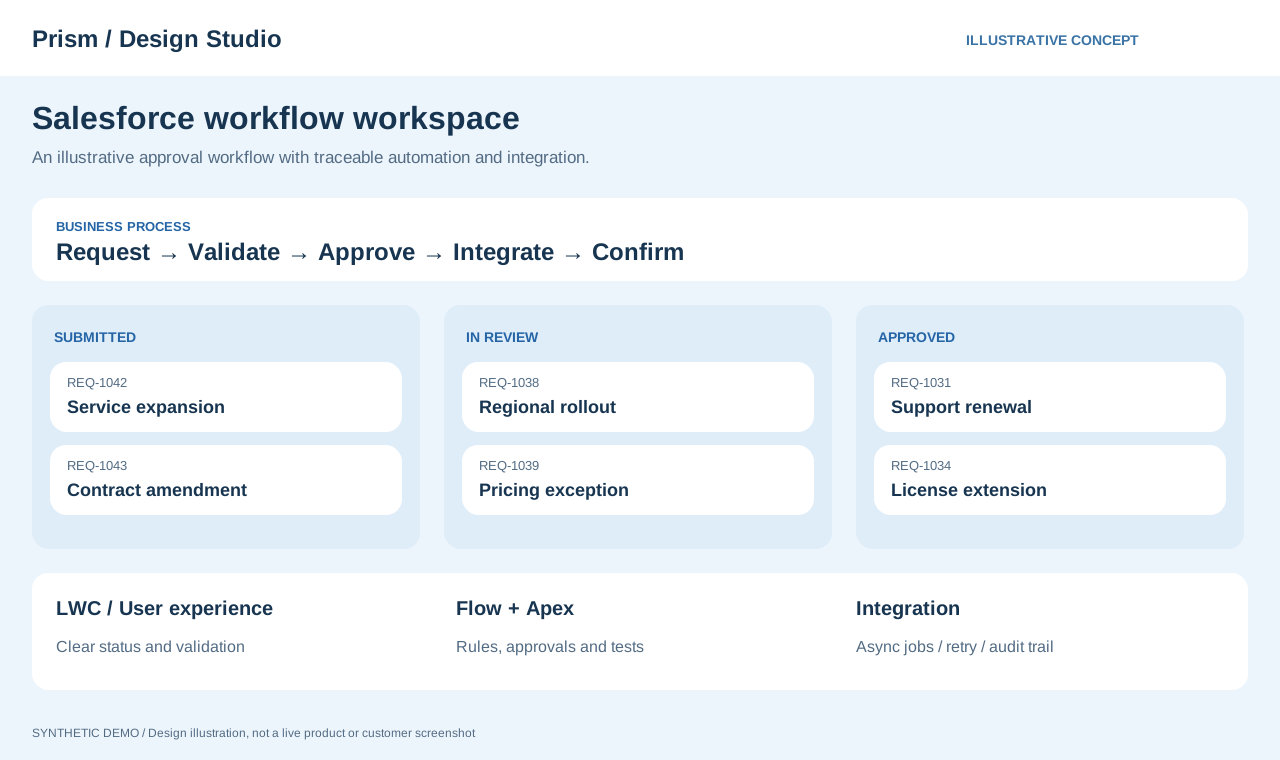
I approach Salesforce applications through the connections between interfaces, logic, data and permissions. With LWC, Apex, Flow, SOQL and external APIs, I focus on consistency with existing behavior and making the user's next action clear.
01 / APPLICATION
Separate interface and processing responsibilities
Map the full path from user input to results, clarifying the responsibilities of the interface, server processing and automation.
LWC
Define input, loading, completion and failure states so the interface makes the next available action clear.
Apex / Flow
Consider complexity, maintainability and execution order, and review interactions with existing automation.
Permissions and data
Check object, field and record access separately. Distinguish being able to see an interface from being allowed to update its data.
02 / INTEGRATION
Design integrations for failure as well as success
For external communication, plan how to identify failures and retry safely as well as how to send successfully.
Field mappings
Define types, required values, nulls and time handling, confirming that fields have consistent meanings across systems.
Asynchronous processing
Consider processing volume and response times while designing traceable task states and results.
Duplicates and retries
Consider external keys or processing history and define what should happen when a request is submitted again.
03 / QUALITY
Test the business expectations
Check data results, permissions and exceptional behavior, not just whether execution has finished.
Success and exception paths
Define expected results for missing input, absent targets and external service errors.
Bulk records
Check results and platform limits for bulk processing as well as individual records.
Verify through the interface
Combine automated tests with checks of actual interaction sequences, messages and the display after saving.